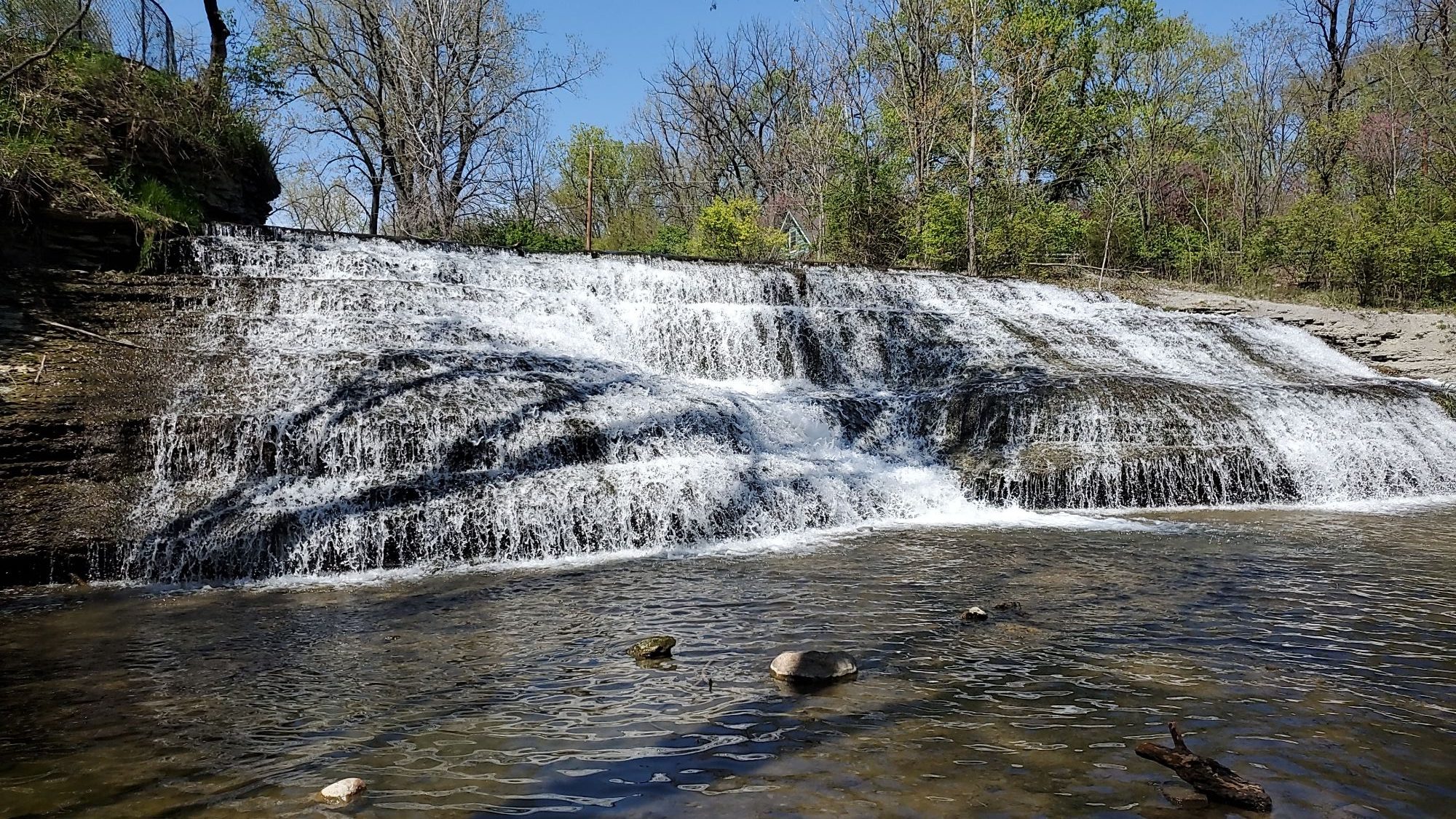
Thistlethwaite Falls is a common place for people to come and cool off in the water, go for a hike, or to gaze at the beautiful falls. Several stories have come about overtime regarding the origin of the waterfall. Some of them insinuate the falls have existed since the area’s discovery. One account from 1910 tells of when the first settlers arrived in Richmond in 1806. The natural advantages of the area led them to name the settlement “Promised Land”. It was mentioned the land surrounding the falls was uninhabited aside from six Indians encamped there. The Indians offered to take the settlers south to show them the nearby land as a trade for what goods the settlers had with them. With the aid of the natives, they eventually headed east to a large hill with natural springs surrounding its base. The hill and surrounding area is believed to be present day Glen Miller Park. A large number of Indians were camped near the springs. The settlers then moved south and began to build cabins along the river, just south of where National Road lies today. Among the original settlers who travelled with the Indians was David Hoover, the first person credited to explore the land where the city originated, as well as the first to travel the countryside north of the city. The city was laid out ten years later by John Smith, who named the city after his namesake, Smithville. Eventually the city was renamed a third time to its present title of Richmond1. As recent as 2003, the Society for Preservation and Use of Resources (SPUR) claimed the falls are a remnant of an ancient waterfall that migrated upstream for thousands of years2.
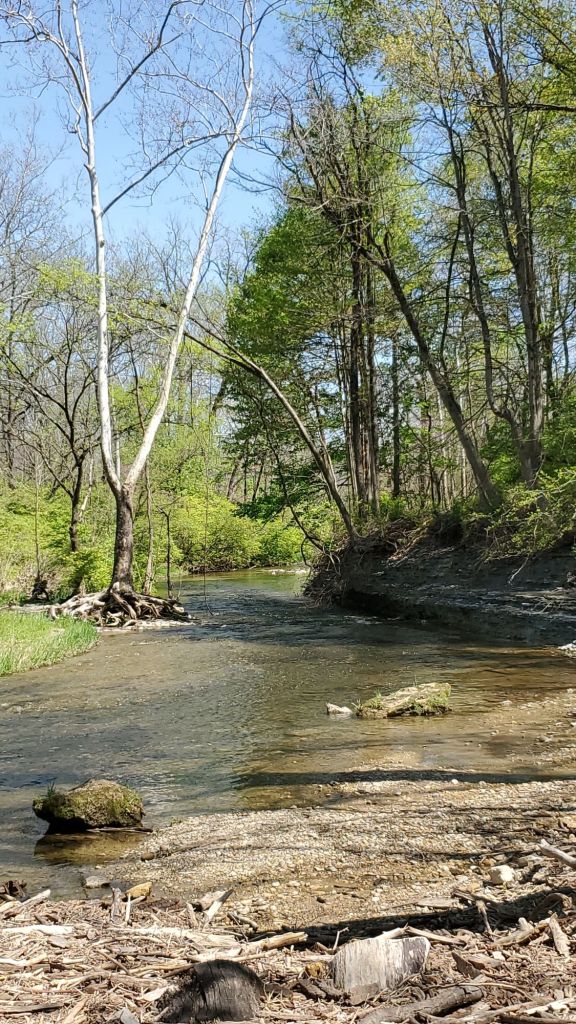
The 1910 publication claiming the falls were already present was printed various times after its original release. David S. Hoover, grandson of the earliest settler, David Hoover, argued against the story that Indians were found near Thistlethwaite Falls in 1806. Rather, he stated Timothy Thistlethwaite purchased the mills around the falls. Thistlethwaite then proceeded to build a dam out of dirt around the south side of the Whitewater Canyon. This created Thistlethwaite Pond. He later detonated a large channel of the river, resulting in the waterfall that remains today3. Unfortunately, Hoover’s article did not end the recirculation of the “Land of Promise” story. However, the true history of Thistlethwaite Falls is posted on signs at the site of the falls. The waterfall was dedicated an historical marker by the National Society of Colonial Dames XVII Century on May 18th 1996. A special thank you was presented to John Thistlethwaite, the great-great-grandson of Timothy Thistlethwaite4.
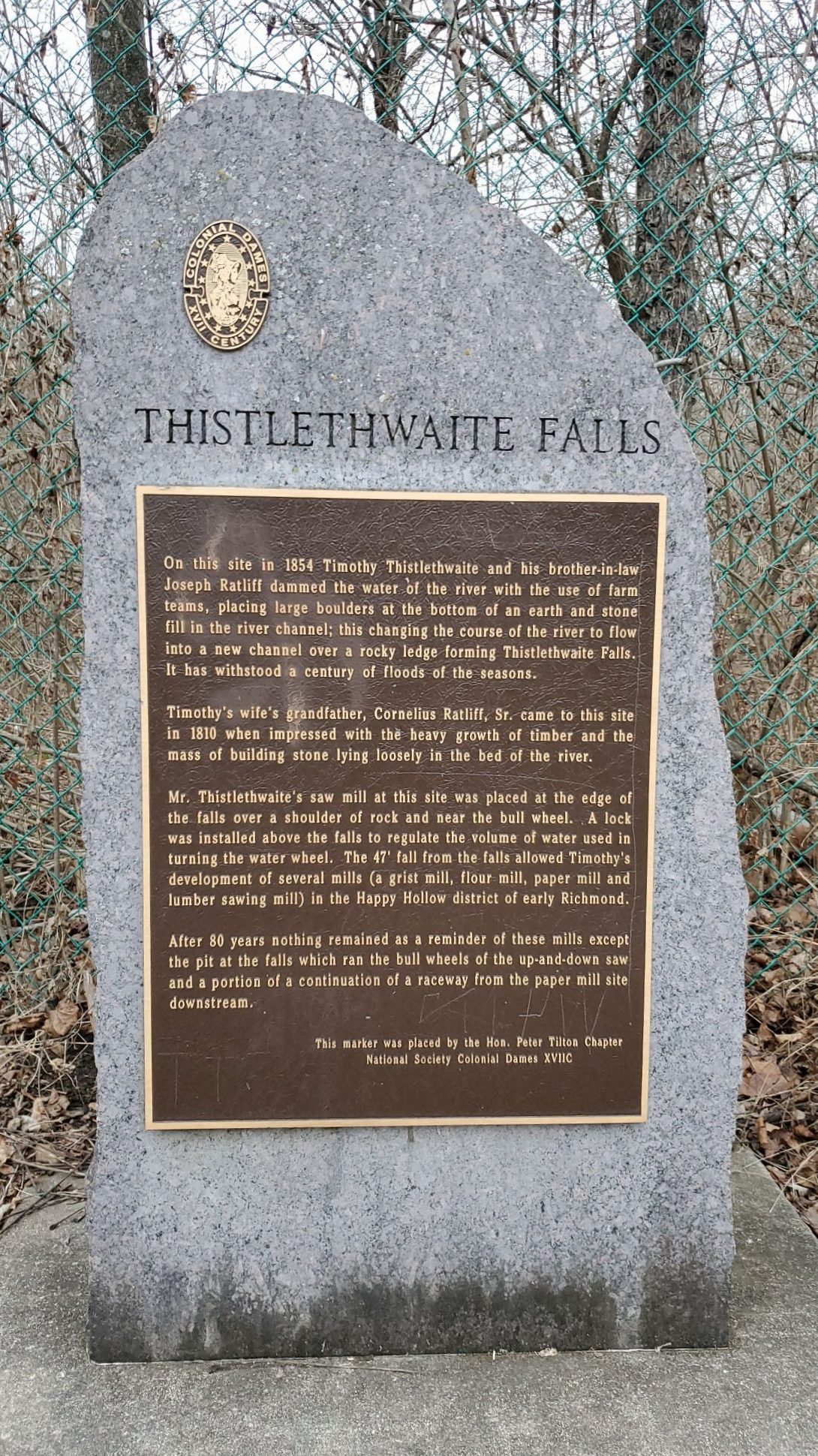
Timothy Thistlethwaite and his brother-in-law Joseph Ratliff dammed the Whitewater River and blew up a forty-seven-foot rock ledge in 1854. Thus, the falls were created5. Thomas Newman built the first mill near the falls in 1825. The flour mill was powered by the river. A new water wheel was later constructed, causing a need for a dam. Once the dam was built, the water was carried much lower than before. The flour mill stood until the 1880s when it succumbed to a fire6. Business expanded to five local mills in the area, each powered by the falls. All that remains of the former mills are the pit under the falls which ran the old mill’s bull wheels and part of the race created to guide the water near the mills7. In 1919, it was proposed by Councilman Thatcher that the falls be used by the city in some way. Mayor Zimmerman rejected the idea, stating it would be more costly than profitable to utilize the falls in such a way8.

The man-made falls and the surrounding Whitewater valley have been an avid location for educational purposes. The earliest newspaper mention of the falls was in 1892 when the Indiana Academy of Science held their annual meeting at Earlham College. The first day on their agenda was May 12th, which consisted of heading to Thistlethwaite Falls on foot and examining cliffs along the Whitewater valley on their way back. The gorge was described as seventy-feet deep and the natural walls were bountiful with a large variety of fossils. Later that day, the congregation would travel by carriage five miles down the river to Elkhorn Falls. There, they would experience opportunities for geology, botany, entomology, and fishing9. In 1908 geology students from the University of Illinois visited Elkhorn Falls, Thistlethwaite Falls, Sedgwick Rock, Tulip-tree Mound, and fossil beds in Clear Creek and Lick Creek Parks10.
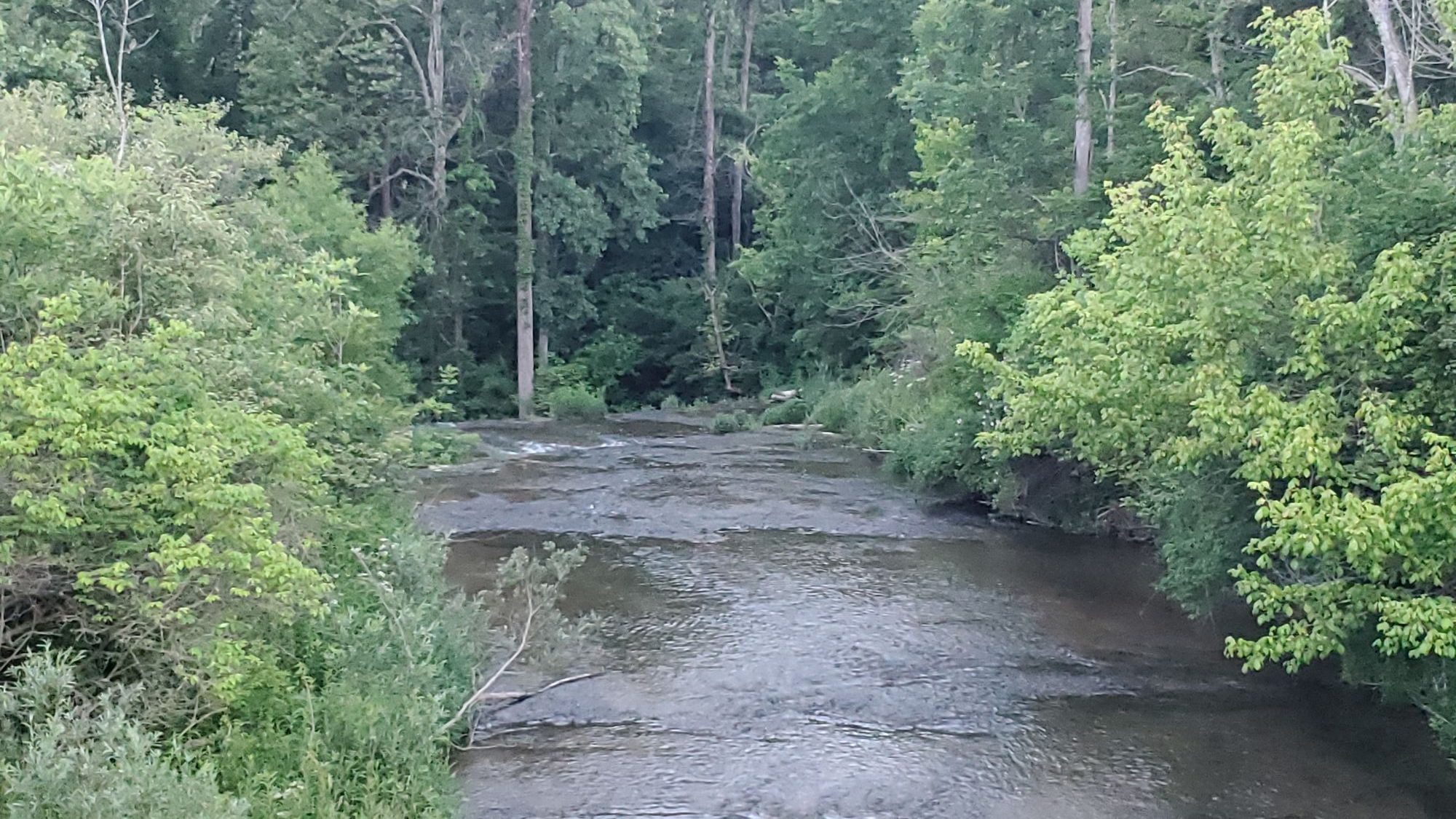
Third grade students from across Richmond had a field trip to the falls for a geographical expidition11. Teachers and Superintendent T. A. Mott accompanied roughly 200 pupils to teach them about erosion and the work of streams12. Dennis Junior High School’s geology and astronomy club took a trip west to the falls on April 24th 1929. The club members learned about fossils and various types of rocks13. Malcolm Stover was a junior at Morton High School when he discovered a rare species of jellyfish. The craspedacusta sowerbii is only about three quarters of an inch in diameter. Shortly after finding it, the species disappeared. The public was warned to watch out for the small jellyfish following year14.
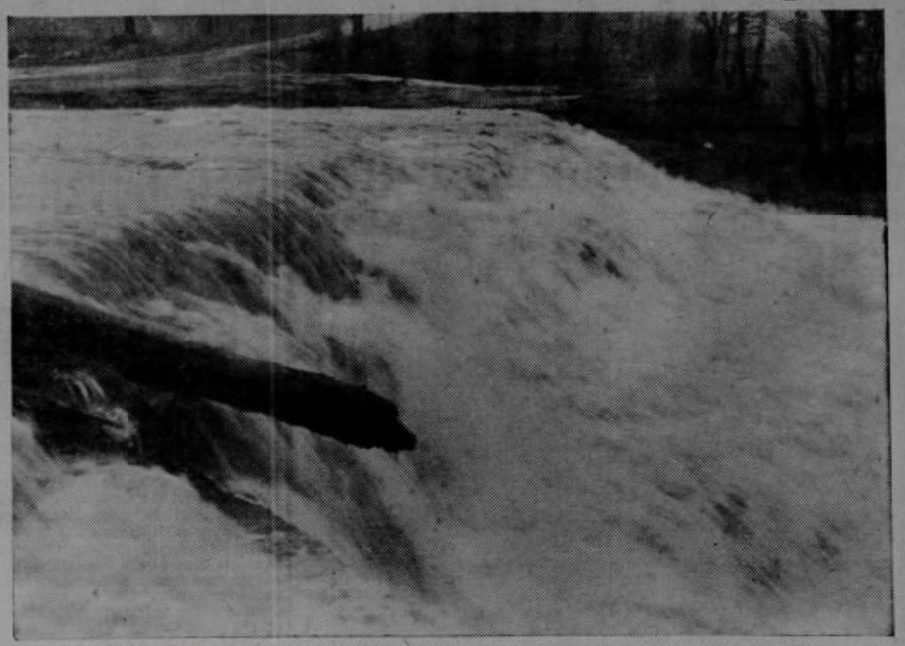
In 1900, it was urged there should be a bridge built above the falls as the ford had been washed away and was nearly impassable15. It wasn’t until almost half a century later the Wayne County surveyor, Dell B. Davis, announced a 100-foot bridge had bypassed the old ford to create a more direct route just north of the falls. Construction began in October and was to open December 16th 1949. The newly constructed bridge cost the city $20,00016. Less than a month after the bridge opened, a raging flood covered the entirety of the bridge. Howard Baker of Richmond and Bob Fulton of Lynn were stranded on the bridge when the excess water began to flow into their car. A wrecker was called to pull the car to safety. By the time the wrecker came, the car was sitting in three-feet of water17. Four years prior to the bridge’s construction, a heavy fog was to blame when Charles Long drove off the road and into the falls on October 20th 1945. He narrowly escaped without serious injury, leaving the car hanging on the end of the waterfall. When Sherriff Sperling arrived, he found the car holding onto the lip of the falls by only the back tires18.

Thistlethwaite falls serves as a scenic destination along multiple trails. A Thanksgiving cross country race was held in 1909, with ten young men from the YMCA participating in the run. The five-mile course began on twelfth street towards the river, then up New Paris Pike and back, crossing the river near Reid Hospital. Then their shoes were kicked off while they forded the icy stream of the White River to Thistlethwaite Falls and back. Herbert Cotton led the way as the race’s first finisher19. Since then, the Cardinal Greenway has been paved nearby out of the former Chesapeake and Ohio railway. A gorge trail also starts at the falls and stretches nearly four miles to Test Road. The ribbon-cutting of the gorge trail was officiated by Mayor Clifford Dickman on April 17th 198320.
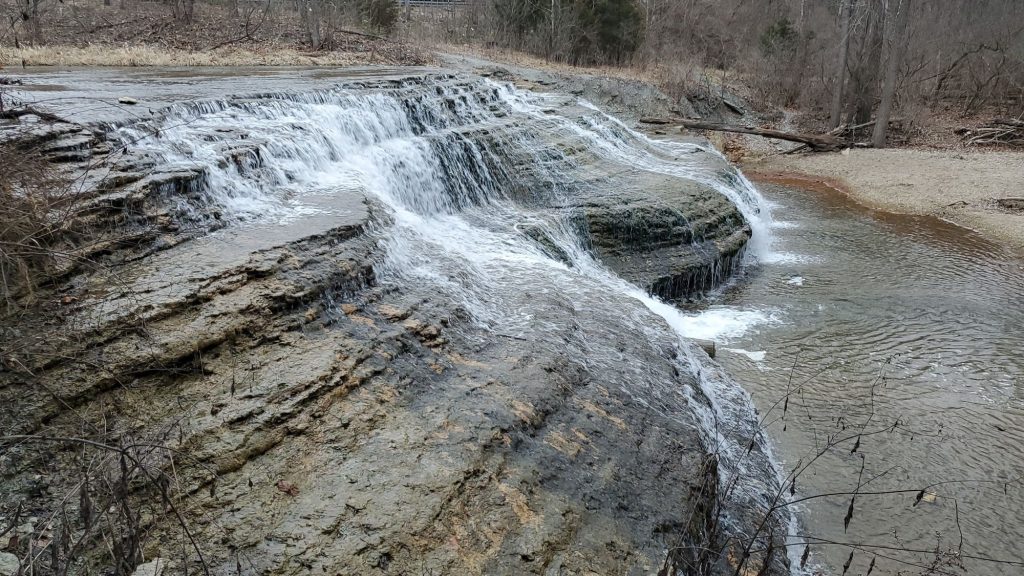
Police were reported to a swimming party that took place at the top of the falls. It was reported that young men and women were in attendance and bathing suits were not worn by all21. The swimming party took place on June 26th 1910. Seven young boys drew near the party to peep at the young women gathered there. The women noticed the peeping toms but not soon enough to cover up. The women began to throw rocks at the boys as they scurried to dress themselves in front of their surprise visitors. The husband of one of the women, Roy Combes, chased one of the boys, Eddie Woolford, two blocks while chucking rocks at him. Judge Abbott deemed the chase and the injuries from rock hurling unwarranted and fined Combes $122 (worth $35.05 today).
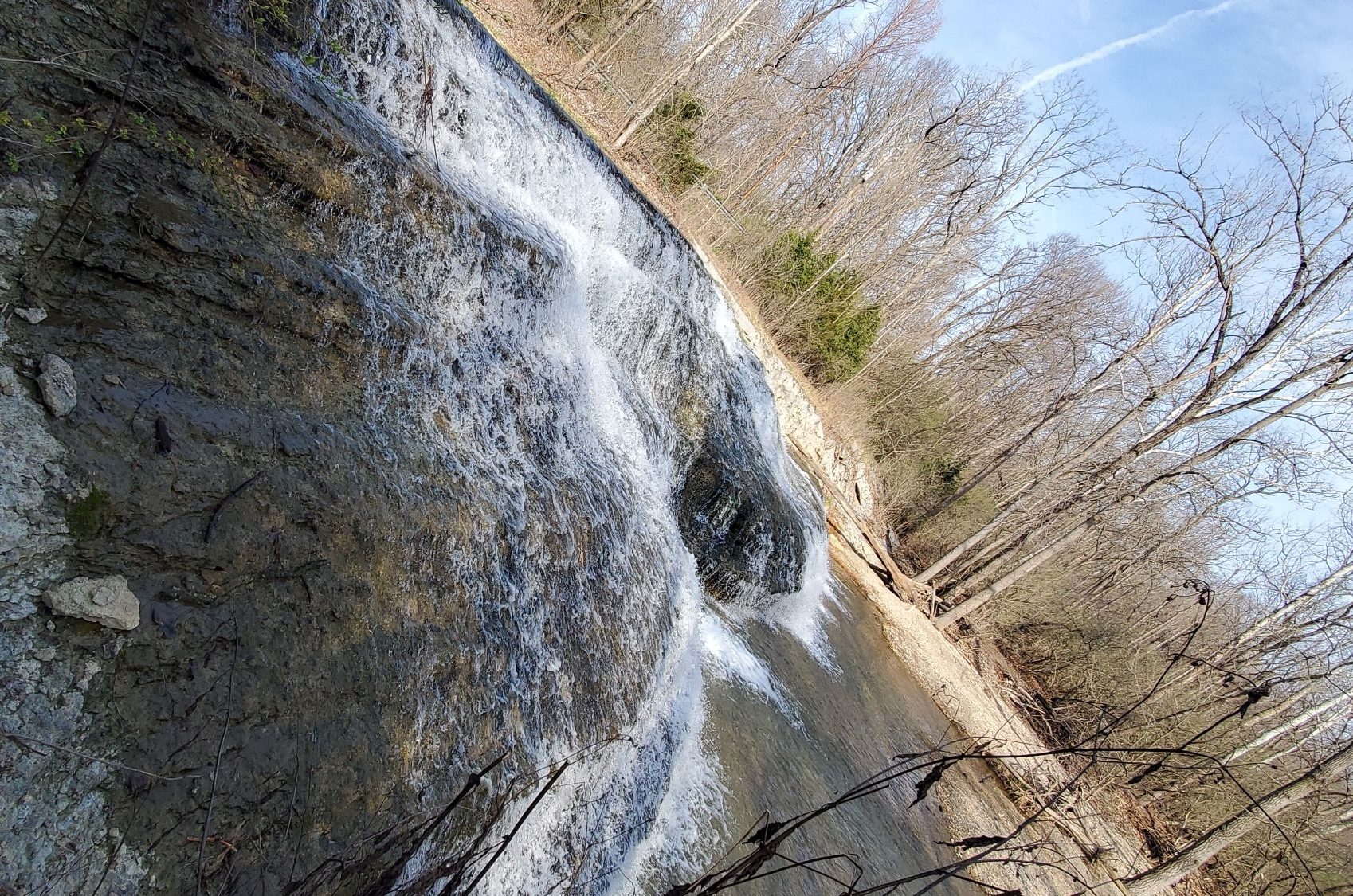
Motorists traveled to the falls to utilize the streams above to wash their vehicles23. A hoard of automobiles would swarm the falls in early spring as a sign warm weather had arrived24. In 1983, the Environmental Protection Agency and the Indiana Board of Health requested the Richmond Sanitary District prove they meet their standards for water purity. Parking upstream caused soap and grime to wash down the river, resulting in the sanitary district asking motorists to stop washing their vehicles over the falls25.
Sources:
1. Richmond, When First Settled Was Called “Land of Promise”. 1913 November 14. Palladium-Item. P 11.
2. Richmond trails can offer trekkers a walk through time. 2003 June 15. The Star Press. P 31.
3. Hoover Says Thistlethwaite Falls Not Natural Formation. 1948 January 13. Palladium-Item. P 5.
4. Marking of Thistlethwaite Falls importance to historic preservation. 1996 May 17. Palladium-Item. P 8.
5. Shideler, T. The legend of Thistlethwaite Falls. (2025 January 23). Hiding in Plain Site. Web. Retrieved June 26 2026.
6. Happy Hollow Once Busy Place in Richmond; Well Remembered by Older Citizens of City. 1942 December 9. Palladium-Item. P 26.
7. (see footnote 5)
8. Palladium-Item. 1919 February 18. P 8.
9. Indiana Academy of Science. 1892 May 6. The Richmond Item. P 1.
10. Geology Field Course A Success. 1908 September 24. The Daily Illini. P 4.
11. Pupils have excursion. 1909 November 11. P 6.
12. Pupils Study Erosion. 1911 June 2. The Richmond Item. P 6.
13. Dennis baseball under way; pupils observe health week. 1929 May 11. Palladium-Item. P 18.
14. Morton Student Is Discoverer of Rare Jelly Fish Species. 1931 September 24. Palladium-Item. P 7.
15. Local News. 1900 March 17. Palladium-Item. P 4.
16. Formal Bridge Opening Set For Monday. 1949 December 16. Palladium-Item. P 37.
17. Flash Flood Rages Through Lowlands. 1950 January 16. Palladium-Item. P 1.
18. Auto “Hung Up” on Edge of Falls’ Fog Is Blamed. 1945 October 21. Palladium-Item. P 1.
19. Cross Country Run. 1909 November 26. The Richmond Item. P 2.
20. The Gorge. 1983 April 17. Palladium-Item. P 9.
21. Back to Nature. 1910 June 30. The Richmond Item. P 4.
22. Watched women bathe; is struck. 1910 July 6. The Richmond Item. P 8.
23. The Cincinnati Enquirer. 1949 June 19. P 120.
24. Another Sign of Spring. 1938 March 22. Palladium-Item. P 9.
25. Don’t use river as a cheap car wash. 1983 June 16. Palladium-Item P 7.
 Detours Through Time
Leave a comment